Gods
Within Hinduism a large number of personal gods (Ishvaras) are worshipped as murtis. These beings are significantly powerful entities known as devas. The exact nature of belief in regards to each deity varies between differing Hindu denominations and philosophies. Often these beings are depicted in humanoid or partially humanoid forms, complete with a set of unique and complex iconography in each case. The devas are expansions of Brahman into various forms, each with a certain quality. In the Rig Veda 33 devas are described, which are personifications of phenomena in nature.
Ganesha
Easily recognizable as the elephant-deity riding a mouse, Ganesha is arguably he most popular Hindu God, and one of the commonest mnemonics for anything associated with Hinduism. The son of Shiva and Parvati, Ganesha is depicted has having a curved trunk and big ears, and a huge pot-bellied body of a human being. He is the lord of success and destroyer of evils and obstacles. He is also worshipped as the god of knowledge, wisdom and wealth.
Shiva
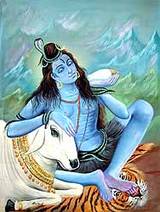
The most powerful and fascinating deity in Hinduism, who represents death and dissolution. One of the godheads in the Hindu Trinity, and known by many names - Mahadeva, Pashupati, Nataraja, Vishwanath, Bhole Nath - Shiva is perhaps the most complex of Hindu deities. Hindus recognise this by putting his shrine in the temple separate from those of other deities and worshipping Shiva as a phallic symbol called the ‘Shiva Limgam’ in most temples.
Saraswati
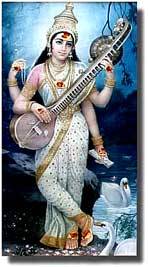
Saraswati, the goddess of knowledge and learning, represents the free flow of wisdom and consciousness. She is the mother of the Vedas, and chants to her, called the 'Saraswati Vandana' often begin and end Vedic lessons. The goddess of wisdom, art and music, she is the daughter of Lord Shiva and Goddess Durga. It is believed that goddess Saraswati endows human beings with the powers of speech, wisdom and learning.